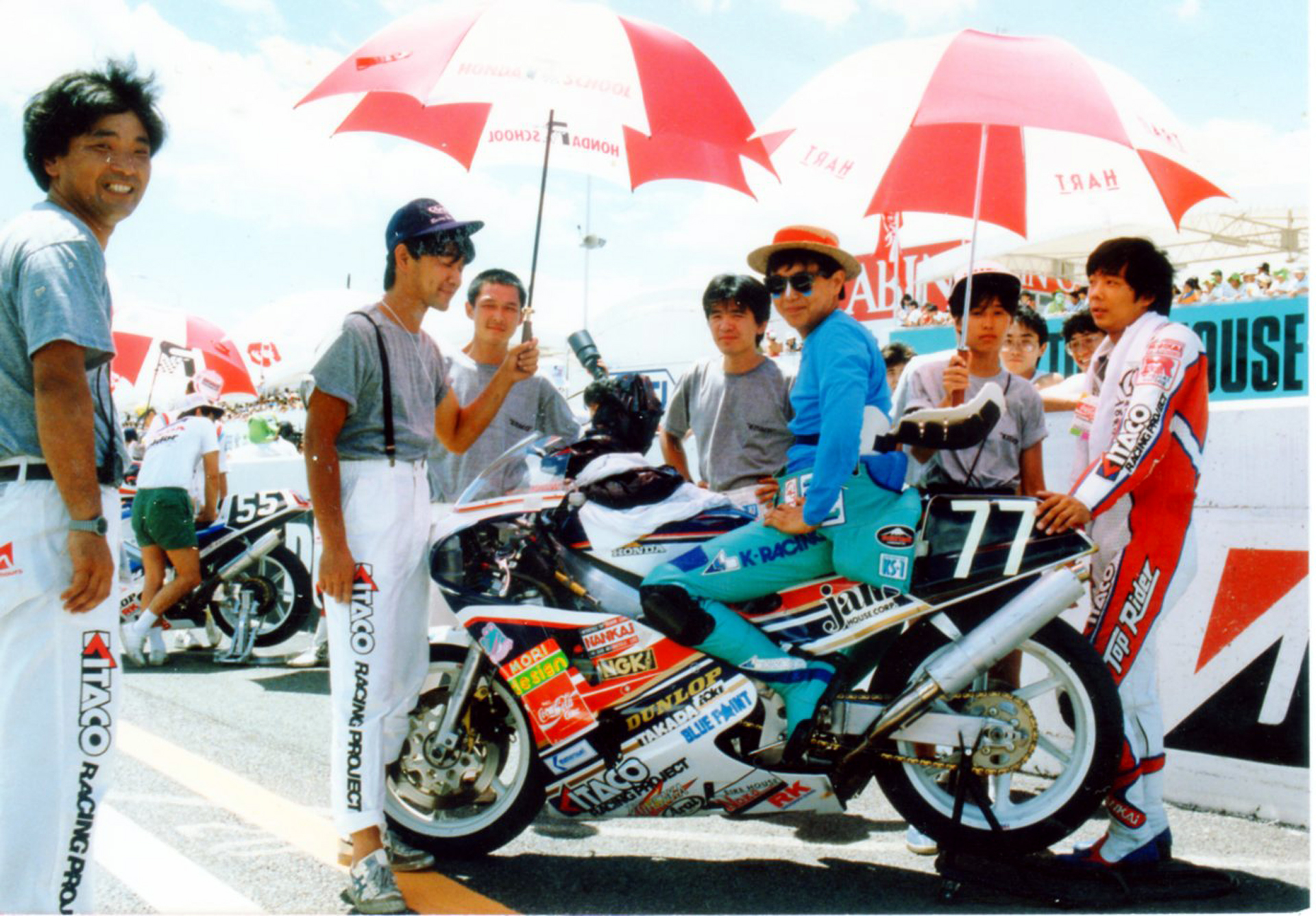
⑤穴があったら入りたい27才の時
1987年のこと レースを職としてか
ら初めて大島正というライダーのメカから始まったのである。彼はノービスクラスのチャンピオンになったが交通違反で運転免許が取り消しになったのである。
⑤ I wanted to crawl into a hole. I was 27 years old in 1987. My first job
as a racer was as a mechanic for a rider named Tadashi Oshima. He had become
the Novice Class champion, but his driver's license had been revoked due
to a traffic violation.
⑤ Eu queria me enfiar num buraco. Eu tinha 27 anos em 1987. Meu primeiro
trabalho como piloto foi como mecânico de um piloto chamado Tadashi Oshima.
Ele havia se tornado campeão da categoria Novato, mas sua carteira de habilitação
havia sido cassada devido a uma infração de trânsito.
運転免許書はレース場の車検の際にツナギ、ヘルメット、グローブ、ブーツと免許証が必要なのである。クラスは一番上の国際A級となったが免許がないためにレースに出れないという事になった。
彼は離婚していた母方の養子となり別姓になり免許証を取得したのだH系販売店からワークスマシンRVFに乗って鈴鹿8時間耐久レースに出ていた。 8時間耐久レースでは不運にもガソリンチャージの際に静電気が火種となりピットでマシンが燃えてしまったのである。
僕と組んだ時のマシンはVF750Fであった。 750cc で125psぐらいだった車重は約180kg程度で外見はノーマルのためパワーウエイトレシオは1.450くらいだ僕も何回かサーキット、臨海(内緒だよ!)で乗ったことがあるが強烈に速い1速では前かがみにならないと前輪が簡単に浮いてくる2速でも気を抜くとウィリーをしてしまうのである。
最高速は鈴鹿で270km/hくらい出ていたと記憶する。
A driver's license, along with overalls, helmet, gloves, and boots, is
required for vehicle inspection at the race track. Although he was ranked
in the highest class, International Class A, he was unable to race without
a license. He was adopted by his mother, who was divorced, and obtained
a driver's license under a different surname. He competed in the Suzuka
8 Hours endurance race on a factory RVF from an H-series dealership. Unfortunately,
static electricity sparked a fire while filling the gas tank during the
race, causing the car to catch fire in the pit. The machine we partnered
on was a VF750F. It had a 750cc engine, around 125 horsepower, weighed
about 180 kg, and looked stock, giving it a power-to-weight ratio of around
1.450. I've ridden it a few times at the Rinkai Circuit (a secret!), and
it was incredibly fast in first gear, so if you didn't lean forward, the
front wheel would easily lift off the ground. Even in second gear, if you
weren't careful, it would do a wheelie. I recall it reaching a top speed
of around 270 km/h at Suzuka.
Para a inspeção do veículo na pista de corrida, é necessário ter carteira
de habilitação, além de macacão, capacete, luvas e botas. Apesar de estar
classificado na categoria mais alta, a Classe A Internacional, ele não
podia competir sem habilitação. Ele foi adotado pela mãe, que era divorciada
e obteve a carteira de habilitação com um sobrenome diferente. Ele competiu
nas 8 Horas de Suzuka, uma corrida de resistência, a bordo de uma RVF de
fábrica, comprada em uma concessionária da série H. Infelizmente, a eletricidade
estática provocou um incêndio enquanto ele abastecia o tanque de gasolina
durante a corrida, fazendo com que o carro pegasse fogo nos boxes. A moto
que pilotamos em parceria era uma VF750F. Ela tinha um motor de 750cc,
cerca de 125 cavalos de potência, pesava aproximadamente 180 kg e parecia
original, o que lhe dava uma relação peso-potência de cerca de 1,450. Eu
a pilotei algumas vezes no Circuito Rinkai (segredo!), e ela era incrivelmente
rápida em primeira marcha; se você não se inclinasse para a frente, a roda
dianteira levantava facilmente do chão. Mesmo em segunda marcha, se você
não tomasse cuidado, ela empinava. Lembro-me de ter atingido uma velocidade
máxima de cerca de 270 km/h em Suzuka.
しかしワークスマシンのRVFはこの当時からずば抜けて速いのである。 車重135キロ、135psとしてもパワーウエイトレシオは1.000となる。
車重135キロはレギュレーションの最低重量であった。 ワークスマシンはパワーウエイトレシオ1.0以下にしているのだ、当時は750ccでは、このあとに出るRC30のスペシャルエンジン(NL0B)でも142ps程度が限界だった。
’93年モデルではシリンダーヘッドのインレットポートが20mm短くなりポート形状もSTDより細くなっていたのだ。’93年モデルはワークスマシンと同じシリンダーヘッドが提供されていたのだ。
このエンジンは、組み上げる前に0.4mmの面研をおこない圧縮比を上げたのだ。ピックアップもすごく良い、タコメーター(エンジン回転計)が付いていかないほどであった。それにRAM AIRを採用していたのでストレートでは時速200キロを超えたあたりから加給されるので鈴鹿のストレートエンドでは175マイル(約282キロ)出ていた、更に面研を0.2mm追加して最終的には合計0.6mmの面研をして圧縮比を上げて中低速の立ち上がりを強化したのだ。
レギュレーションの変更で1994年からRC45というマシンに変わるのだがH○Cが提供していたコンプリートエンジンは155psしかなかったのである。
最終的には172ps(ラムエアー圧なしで)出したのである。 このエンジンは、最終的に2基を某H技研鈴鹿製作所社内チーム(鈴鹿レーシング)がお買い上げすることになったのである。
某H社が外部のエンジンをお買い上げするのは今回が初めてのことであった。 今後もないと思う。
However, the factory RVF was exceptionally fast even at that time. Even
with a weight of 135 kg and 135 hp, the power-to-weight ratio was 1.000.
135 kg was the minimum weight allowed by regulations. Factory machines
had a power-to-weight ratio of less than 1.0; at the time, the 750cc engine,
even the later RC30 special engine (NL0B), was limited to around 142 hp.
The 1993 model's cylinder head inlet port was 20 mm shorter, and the port
shape was also narrower than the standard. The 1993 model was offered with
the same cylinder head as the factory machine. This engine underwent a
0.4 mm surface grinding before assembly to increase the compression ratio.
It also had excellent pickup, so much so that it barely kept up with the
tachometer (engine revolution counter). Furthermore, because it used RAM
AIR, boost was applied once the car exceeded 200 km/h on the straights,
resulting in a speed of 175 mph (approximately 282 km/h) at the end of
the straight at Suzuka. An additional 0.2 mm of grinding was added, for
a total of 0.6 mm of grinding, raising the compression ratio and strengthening
the acceleration at low and mid-range speeds. Regulations changed in 1994,
resulting in a change to the RC45 machine, but the complete engine provided
by H○C only produced 155 PS. Ultimately, it produced 172 PS (without ram
air pressure). Two of these engines were eventually purchased by a certain
H Giken Suzuka Factory in-house team (Suzuka Racing). This was the first
time that a certain H company had purchased an external engine, and I doubt
it will happen again in the future.
Contudo, a RVF de fábrica era excepcionalmente rápida mesmo naquela época.
Mesmo com um peso de 135 kg e 135 cv, a relação peso-potência era de 1,000.
135 kg era o peso mínimo permitido pelo regulamento. As motos de fábrica
tinham uma relação peso-potência inferior a 1,0; na época, o motor de 750
cc, mesmo o posterior motor especial RC30 (NL0B), era limitado a cerca
de 142 cv. A porta de admissão do cabeçote do modelo de 1993 era 20 mm
mais curta e o formato da porta também era mais estreito do que o padrão.
O modelo de 1993 era oferecido com o mesmo cabeçote da moto de fábrica.
Este motor passou por um rebaixamento de 0,4 mm na superfície antes da
montagem para aumentar a taxa de compressão. Ele também tinha uma excelente
resposta, tão boa que mal conseguia acompanhar o conta-giros (contador
de rotações do motor). Além disso, como utilizava o sistema RAM AIR, o
aumento de pressão era acionado quando o carro ultrapassava os 200 km/h
nas retas, resultando em uma velocidade de 282 km/h (175 mph) no final
da reta de Suzuka. Um rebaixamento adicional de 0,2 mm foi adicionado,
totalizando 0,6 mm, elevando a taxa de compressão e fortalecendo a aceleração
em baixas e médias rotações. Os regulamentos mudaram em 1994, resultando
na adoção do RC45, mas o motor completo fornecido pela H○C produzia apenas
155 cv. Posteriormente, atingiu 172 cv (sem o sistema RAM AIR). Dois desses
motores foram adquiridos pela equipe interna da H Giken Suzuka Factory
(Suzuka Racing). Essa foi a primeira vez que uma empresa do grupo H comprou
um motor de terceiros, e duvido que isso se repita no futuro.
話を大島正に戻そう。 レースの事も、又の機会に記載することにしよう。
そして翌年に彼からメカニックをしてもらえないかと言われなければこのチャンスがなければ僕のキャリアは変わっていたと思う。彼からの話が来る前に思っていたのは「結果が出ないからもうレースは辞めて、普通の仕事をしないといけないな」と自分自身が考えていたからである。
大島正のチームは某文房具メーカーがついているとのこと、世界的にも有名なメーカーである。
開幕戦の鈴鹿2&4レースが3月21日(記憶では)の土曜日に午前中の予選で僕自身が失敗をして予選中に何度もピットイン、原因はキャブレーターのダイヤフラム(薄いゴム製)の部品の一部がうまくハマっていなかったのである。
タイムは余裕で出したのである(2分24秒)がしかし、最低周回数3周をクリアしていなかった、最低な失敗である。
予選は午前と午後に二回あったが1986年3月21日の正午あたりに大型の寒冷前線が鈴鹿地方を横切ったのである。
鈴鹿のコースはあっという間に積雪30センチくらいになってしまった。
午後からの予選は午後3時からである大雪は30分ほどで止んでしまったので午後からの予選までにはコースに溜まった雪がとけるであろうと僕は願っていたがコース上雪は溶けることなく午後からの予選は全て中止となってしまったのである。
つまり予選落ちという結果になってしまった。
Let's return to Oshima Tadashi. I'll write about the race another time.
And if he hadn't asked me the following year if I'd been his mechanic,
I think my career would have been different. Before he approached me, I
was thinking, "I'm not getting results, so I'll have to quit racing
and get a regular job." Apparently, Oshima Tadashi's team is backed
by a certain stationery manufacturer, a world-famous manufacturer. The
opening race, the Suzuka 2&4 Race, was held on Saturday, March 21st
(as I recall). I made a mistake during the morning qualifying, which required
multiple pit stops. The cause was a part of the carburetor diaphragm (thin
rubber) that wasn't properly seated. I set a comfortable time (2 minutes
24 seconds), but I didn't complete the minimum three laps, which was a
terrible mistake. Qualifying was held twice, once in the morning and once
in the afternoon, but around noon on March 21st, 1986, a large cold front
crossed the Suzuka area. The Suzuka course quickly became covered in about
30 centimeters of snow.
Vamos voltar a falar de Oshima Tadashi. Escreverei sobre a corrida em outra
ocasião. E se ele não tivesse me convidado para ser seu mecânico no ano
seguinte, acho que minha carreira teria sido diferente. Antes de ele me
abordar, eu pensava: "Não estou conseguindo resultados, então terei
que desistir das corridas e arrumar um emprego normal". Aparentemente,
a equipe de Oshima Tadashi é patrocinada por uma certa fabricante de artigos
de papelaria, uma fabricante mundialmente famosa. A corrida de abertura,
a Suzuka 2&4, foi realizada no sábado, 21 de março (se não me engano).
Cometi um erro durante a qualificação da manhã, o que exigiu várias paradas
nos boxes. A causa foi uma parte do diafragma do carburador (uma fina peça
de borracha) que não estava encaixada corretamente. Fiz um tempo razoável
(2 minutos e 24 segundos), mas não completei as três voltas mínimas, o
que foi um erro terrível. A sessão de qualificação foi realizada duas vezes,
uma pela manhã e outra à tarde, mas por volta do meio-dia de 21 de março
de 1986, uma grande frente fria cruzou a região de Suzuka. O circuito de
Suzuka ficou rapidamente coberto por cerca de 30 centímetros de neve.
穴があったら入りたい !
If there was a hole, I'd crawl in !
Se houvesse um buraco, eu rastejaria para dentro dele !
そしてスポンサーの話は手形詐欺であることが判明してチームは解散したのである。 4月初旬のこと、そして僕は大島正と二人で全日本選手権に出場することにしたのだ鈴鹿での失敗はに二度としないと誓ったのである。
4月の鈴鹿サーキットのラウンジでHRCの設計の方と大島正が乗るフレームを作る話をする。
このフレームを5月末〜7月耐久ウィークの木曜日15時頃に鈴鹿サーキットに持ち込んだ… 設計はHRC 、製作は東京ブルーポイントで行い僕も5月末から東京へ。
筑波のレースも直接サーキット入りをした。 語り尽くせない時間がついやされる… TT -F1クラスをプライベートで全日本を回るしかもマシンのメンテナンスをしながらアルバイトもするとっても貧しく貧弱なチームの開始である。
マシンは忠実にメンテナンスをしてトラブルを起こさないと誓ったのである。 そして6月の鈴鹿200kmでは大雨の中、6位に入賞したのである。 この頃のレースは国内4メーカーが各4台程度のワークスマシンを走らせている勘定すれば16台程度が走っている。
The sponsor story turned out to be a bill fraud, and the team was disbanded.
It was early April, and Tadashi Oshima and I decided to enter the All Japan
Championship together, vowing to never repeat the mistake we made at Suzuka.
In April, I met with an HRC designer in the lounge at Suzuka Circuit to
discuss creating a frame for Tadashi Oshima to ride.
A história do patrocinador acabou sendo uma fraude na fatura, e a equipe
foi dissolvida. Era início de abril, e Tadashi Oshima e eu decidimos participar
juntos do Campeonato Japonês, prometendo nunca repetir o erro que cometemos
em Suzuka. Em abril, encontrei-me com um designer da HRC no lounge do Circuito
de Suzuka para discutir a criação de um quadro para Tadashi Oshima usar.
この年の全日本選手権TT-F1クラス年間ランキング10位を獲得したのである。
That year, he finished 10th in the All Japan Championship TT-F1 class annual
rankings.
Naquele ano, ele terminou em 10º lugar no ranking anual da classe TT-F1
do Campeonato Japonês de Automobilismo.
翌年に彼はブルーフォクス(HRC直下のチーム)というチームに入り1989年と1990年に鈴鹿8時間耐久レースで2年連続2位に入ったのだ。 また、1988年の菅生レースではポールツーフィニッシュを果たした。
僕はその頃、東大阪にある二輪部品商社でTT-F1、TT-F3のクラスを担当することになりこの菅生のレースでは7位に入賞していた。 いろいろ、あったこの頃の話はまたの機会があればアップすることにしよう。
この年が無ければ、僕の存在は無かったと言っていいと思う。
僕、自身が大きく変わった年である。
The following year he joined the Blue Fox team (a team directly under HRC)
and came in second place in the Suzuka 8 Hours for two consecutive years
in 1989 and 1990. He also achieved a pole-two finish at the 1988 Sugo race.
At the time, I was working for a motorcycle parts trading company in Higashi-Osaka,
in charge of the TT-F1 and TT-F3 classes, and came in seventh in the Sugo
race. There was a lot going on at that time, but I'll write about it another
time. I think it's fair to say that without that year, I wouldn't be who
I am today. It was a year in which I changed a lot.
No ano seguinte, ele se juntou à equipe Blue Fox (uma equipe diretamente
subordinada à HRC) e conquistou o segundo lugar nas 8 Horas de Suzuka por
dois anos consecutivos, em 1989 e 1990. Ele também obteve a segunda posição
na corrida de Sugo em 1988. Na época, eu trabalhava para uma empresa de
comércio de peças de motocicletas em Higashi-Osaka, responsável pelas categorias
TT-F1 e TT-F3, e terminei em sétimo lugar na corrida de Sugo. Muita coisa
estava acontecendo naquele período, mas escreverei sobre isso em outra
ocasião. Acho que posso afirmar com segurança que, sem aquele ano, eu não
seria quem sou hoje. Foi um ano em que mudei muito.
(BACK)